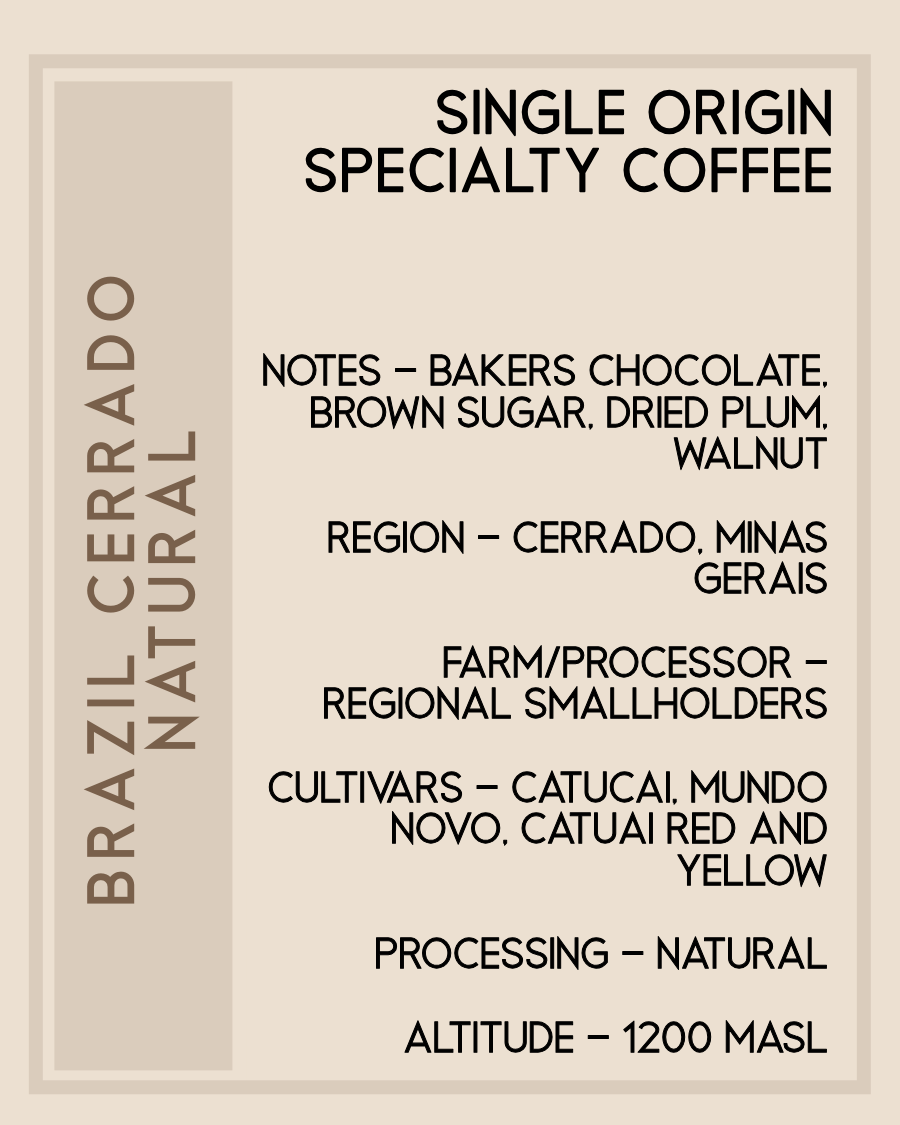
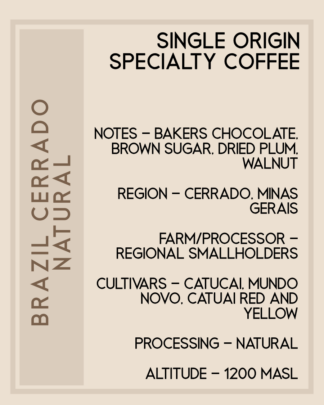
A classic Brazilian coffee, nuts and baker’s chocolate out front, with juicy dark fruit notes, full bodied and robust. Roasted slowly to medium-dark, this bean brews up a sturdy and slightly sweet cup. Lighter roasts accentuate the plum notes with a bit less chocolate bitterness.
Although Cerrado is one of Brazil’s relatively new coffee-growing regions, it has quickly risen to earn a reputation for high quality specialty coffee. Cerrado coffee offers coffee roasters consistency. The land is kept balanced and fertile by well-defined wet and dry seasons and abundant sunlight. Coupled with advanced farming practices and the entrepreneurial spirit from Cerrado’s coffee producers, the region has become renowned. Most medium-to-large-sized farms span anywhere between a few hundred acres to massive powerhouse estates.
Cerrado lies in the southwest of Minas Gerais. The land is relatively flat, with altitudes ranging from 900 to 1250 meters above sea level. The level land allows farmers to practice mechanical harvesting that is out of reach for coffee farms on steep hills.
However, Cerrado doesn’t stop with coffee. The region is a vast tropical and subtropical biome that includes forests, marshlands and grassland. Covering more than 20%of Brazil, it is the largest savannah in South America and one of the most biodiverse ecoregions on earth. Roughly 5% of the species on earth call Cerrado home. The ecosystem covers around 21% of Brazil.
Brazil was the first country to implement a formal grading system for classifying coffee beans. In 2002, the Brazilian Official Classification (Classificação Oficial Brasileira, or COB) was standardized by the Brazilian Ministry of Agriculture (MAPA), and they outlined precise protocols for cupping and grading green coffee.
One of the most commonly used quality indicators today is screen size, with the designation 17/18 referring to beans that have passed through a sifter with holes measuring 17/64 to 18/64 of an inch in diameter. While larger beans are often associated with higher quality, screen size is just one of several indicators used to assess coffee quality.
Brazil was the first country to implement a formal grading system for classifying coffee beans. In 2002, the Brazilian Official Classification (Classificação Oficial Brasileira, or COB) was standardized by the Brazilian Ministry of Agriculture (MAPA), and they outlined precise protocols for cupping and grading green coffee.
One of the most commonly used quality indicators today is screen size, with the designation 17/18 referring to beans that have passed through a sifter with holes measuring 17/64 to 18/64 of an inch in diameter. While larger beans are often associated with higher quality, screen size is just one of several indicators used to assess coffee quality.
Reviews
There are no reviews yet.